Monday, November 26, 2012

Cylinder forms part 2

Four cylinder forms, glazed

 
Black Cylinder, with Blue cylinder in background


                      I have spent most of my studio time over the last few weeks glazing some of the various forms I have been working on this semester. These cylinder forms are the first ones out of the kiln so they are first to be posted about. Overall I am pleased with the way the layers of slips, underglazes and glazes work with the textural elements I have pressed into the forms. These vessels have a depth that a photo can not convey accurately. Although these forms are sort of a dead end for my AIB work I learned much from them and will continue to use what I learned and apply it to my future work. I may at some point revisit these forms since I am not one for saying never but for now my work is moving on and seemingly away from these cylinders.
Black cylinder, detail

Blue cylinder


Blue cylinder, detail

Monday, November 12, 2012

Sevres to Slabs and back again

Cut out parts of slabs

Using the Serves forms I had on hand I attached cut out parts from the slabs I have been using to make platters and vessels. I used cut outs in similar shapes as the on the historical vases. Since the  base forms were completely dried I used paper clay to adhere the wet slabs to the surface. I used a lot of slip and water to moisten the forms in the hopes that nothing will crack. After making the first form I started the second. This one is shown in the bottom two images. I am still working on it and have to add more orage slip to the paper clay.  It will be a while before either one is dry enough to fire and I know if this process works or not.

Slabs attached to Sevres form with paperclay

Yellow slip added to paperclay, front view

Yellow slip added to paperclay, side view

Form 2

Form 2, detail

Friday, October 26, 2012

Process


Earthenware slab with stamped pattern

Red Slip on Slab


Slab after being pressed into fire pit screen

Wood covered with slip

Slab after repeated pressings into slip covered wood

The second piece I worked on I used a stamp I made of an A10 Warthog airplane and pressed the slab  into the trees surrounding my studio as well as the side of my studio.
Stamped slab covered with blue slip

Slab being pressed into slip covered tree outside my studio

Slab after being peeled from tree showing the slip remaining on tree.


Slab on another tree

Slab after second tree pressing

Slab on exterior of studio

Slab after being pressed into side of studio

Slab wrapped around third tree

Peeling away slab from tree, showing texture


Third slab stamped and covered with slip


Slab after being pressed into slip covered vines and stone wall
Extension cord covered in slip

Slab after being pressed into extension cord 
I began by making a slabs that had very defined stamped patterns. I then covered the slabs with slip and pressed them repeatedly into various surfaces surrounding my studio. I began to wonder how many times I could press the slabs into things while still retaining some of the original design as well as the structural integrity of the slab. I found that even after multiple pressing some of the stamping was still visible.  Of course I could of just smashed the clay into these surfaces and obliterated the earlier patterns/ textures but my idea with this work is to show how everything that the slab came in contact with left it's mark, it's trace in the clay.


Monday, October 22, 2012

Cylinder Forms Part 1

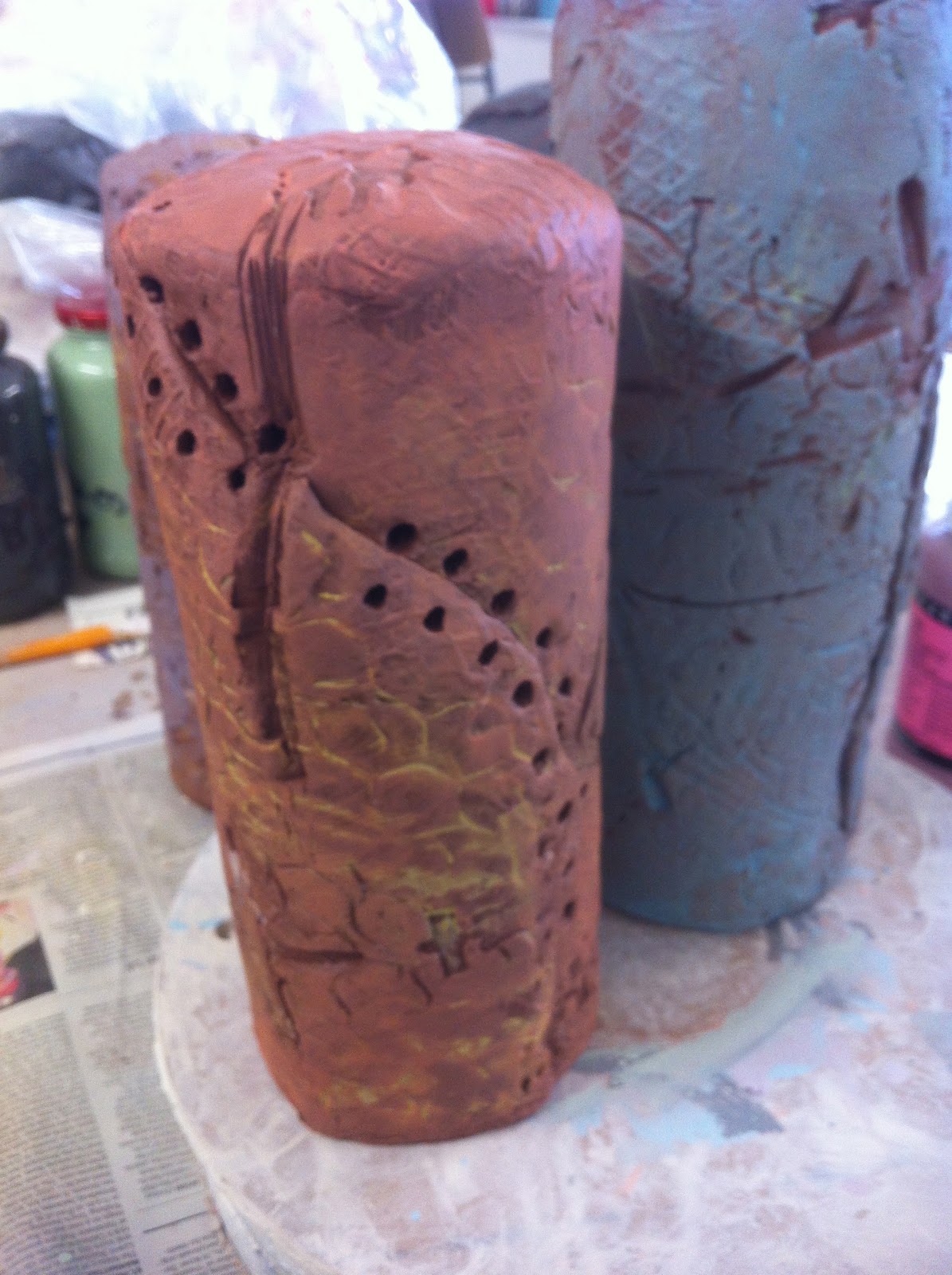
Four Cylinder Forms

Cylinder forms 3&4


Cylinder forms 1&2


Along with the platter series I blogged about in my last post I am continuing with the cylinder forms I began earlier this semester. These are made from soft slabs of earthenware impressed with patterns and textures similar to the platter forms.  I am layering colored slips over the patterns creating more depth and layers to the surface. These are still very much a work in progress and I will update this blog as they get closer to completion.


Cylinder form 2 detail
Cylinder form 1(front) 2(back)


Detail of cylinder form 4

Friday, October 19, 2012

Traces

Traces, Platter form
This platter was created from a slab of clay with patterns pressed into the surface when the clay is soft. The shape is achieved by laying the still soft slab into a plaster mold. The mold I used is one that I made from my Great-Grandmothers china platter. This platter is both a treasured object and a huge bone of contention in my family. When my Great-Grandmother passed away everyone wanted it and since her Will did not name the platter specifically everyone felt they had a claim to it.  My mother is the one who ended up with the platter and I was allowed to borrow it so I could make a plaster mold of it.  I had planned on making a china platter for everyone in the family as a way to heal the rift that this object has caused. I have not given up on this idea but it seems right to use this form for my current work. Traces of my life embedded in my Great-Grandmother's platter.


Saturday, October 13, 2012

Cuneiform.....

Terracotta slab experiments

Detail of slab

Terracotta slab rolled into a cylinder
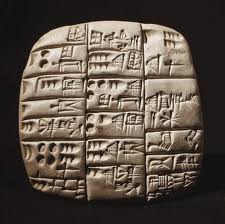
Historical reference of a Cuneiform slab

Historial reference of a cuneiform cylinder


I have been thinking about where my work is heading and about putting meaning into it. This has led me to realize that as beautiful as the Sevres work is it is just not the right path for me. I feel that those types of forms are too similar to the work I was doing before I started the AIB program. One of the main reasons I decided to pursue my MFA was to break free from that and explore ceramics and other media. For the last year I have steered clear of clay until this current semester.  In order to use what I have learned and bring my ideas to life in clay I need to change directions from the Sevres vessels.
 I have always been drawn to the ancient world especially cuneiform writing. Deborah Davidson my advisor from last semester had suggested I look at this more closely but at the time I was not ready, now I am (thanks Deborah for the advice!). Using historical references of cuneiform tablets and cylinders I will incorporate my own "writing" into the clay.  I have begun this by experimenting with terracotta slabs and cylinders made by rolling some of the slabs up around a support. Theses pieces are far from complete but I feel good about this work and its relevance to my ideas.


Tuesday, October 9, 2012

Urn forms based on Sevres Porcelain

yellow slip on urn(pictured without lid)

2 amphora type Urns

Urn form


 After meeting with my mentor last week I have begun a series of Urn forms inspired by Sevres Porcelain. I have been making scaled down versions of the original Sevres Urns (they were 4-5ft high!). I have made some colored slips to use on the surface to replicate the colors used in the Sevres work. Instead of the scrolling florals typically used for decoration during this time period I will be using my own iconography based on military equipment identification manuals that I used during my service in the Air Force. Will post more as they progress.